
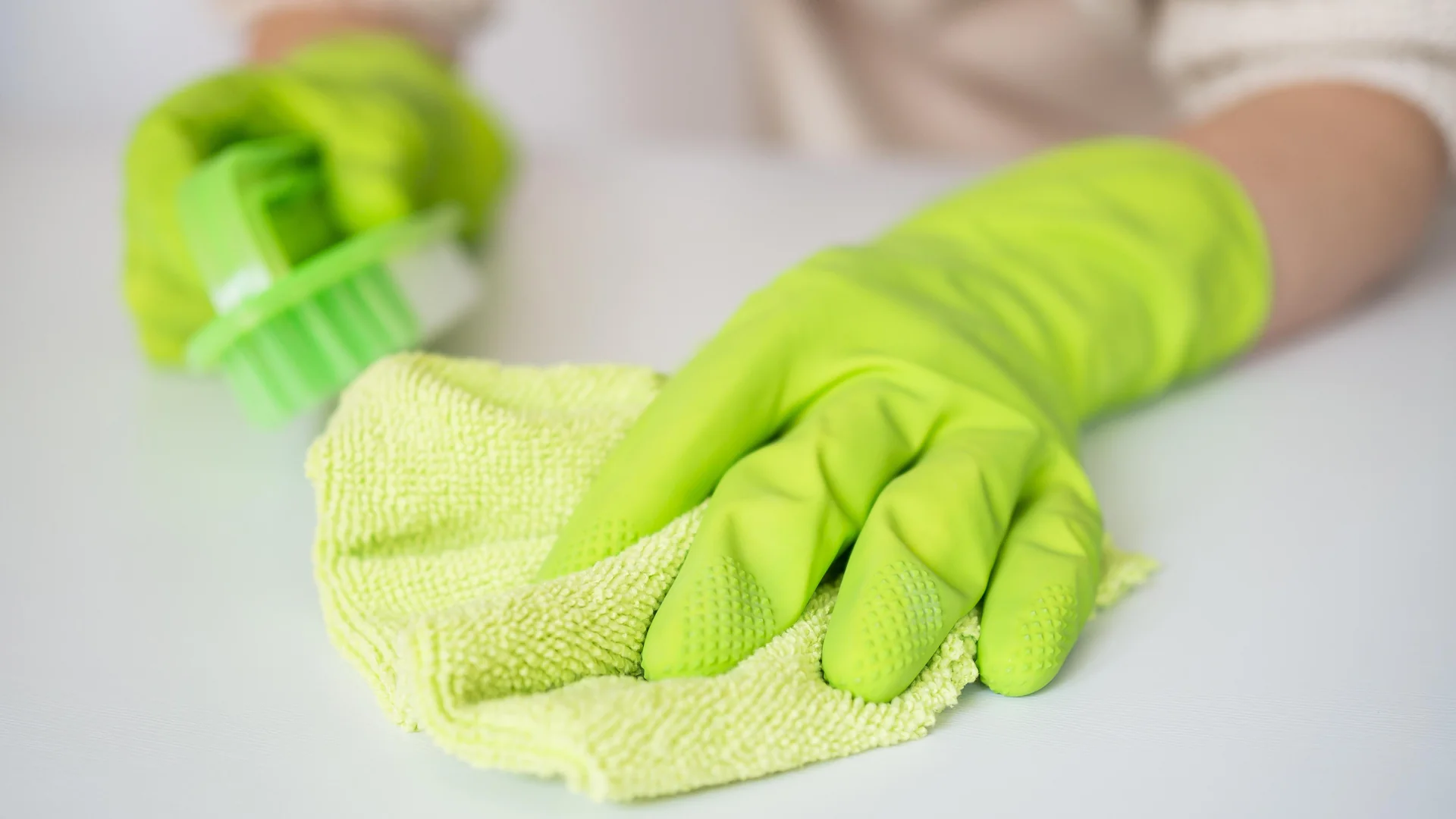
Conventional cleaning products do their job. Surfaces get clean, bacteria get reduced, and the result is visible. The trade-off is less visible: chemical residues left on surfaces your children touch, volatile organic compounds (VOCs) that linger in indoor air hours after cleaning, and synthetic fragrances that mask odors without addressing them.
For most households that adopt eco-friendly cleaning, the decision is not primarily about the environment. It is about what ends up in the air their family breathes, on the floors their children play on, and on the kitchen surfaces where food is prepared.
What eco-friendly cleaning actually means
The term “eco-friendly” is unregulated. Manufacturers apply it freely. Understanding what it should mean, specifically, helps you evaluate any product or service that claims it.
Genuinely non-toxic residential cleaning involves four verifiable criteria.
Plant-derived active ingredients
Conventional surfactants are often petroleum-derived. Effective green cleaning products use surfactants from plant sources: coconut, corn, sugar cane. These clean surfaces comparably well and biodegrade more readily after use.
Absence of specific hazardous ingredients
Products that qualify as non-toxic avoid: bleach (sodium hypochlorite), ammonia, phosphates, phthalates, triclosan, and synthetic musks. The EPA’s Safer Choice program independently certifies products that meet ingredient-level safety standards. Safer Choice certification involves ingredient-by-ingredient review, not just end-product testing.
Low or zero VOC formulation
Volatile organic compounds evaporate into room air after application. Conventional spray cleaners are among the most significant sources of indoor VOC exposure in residential settings. The California Air Resources Board has documented that some conventional cleaning products temporarily elevate indoor VOC concentrations above outdoor levels when used in closed spaces. Low-VOC formulations reduce this exposure without compromising cleaning performance.
Fragrance transparency
Synthetic fragrances are one of the most common hidden exposure sources in household products. Fragrance formulas are legally classified as trade secrets and do not require full ingredient disclosure. Many contain phthalates, which are endocrine-disrupting compounds. Products that are fragrance-free or use disclosed essential oils eliminate this category of exposure.
Why it matters specifically for households with children
Children are not simply smaller adults in terms of chemical exposure risk. Their developing bodies absorb environmental exposures at a higher rate relative to body weight. Their behavior increases exposure: they spend more time on floors, they touch surfaces and then touch their faces, and they are less aware of when surfaces have been recently cleaned.
The American Academy of Pediatrics has published guidance noting that early-life exposures to certain chemical compounds are associated with effects on hormonal development, respiratory health, and neurodevelopment. The AAP recommends reducing unnecessary chemical exposures, particularly during infancy and early childhood.
In practical terms, this means residential cleaning services in Birmingham, AL that serve households with young children should use:
- Non-toxic floor cleaners, since floors are where infants spend the most time
- Fragrance-free products in nurseries and children’s rooms
- Surface cleaners that do not leave chemical residue on countertops or tables where children eat
- Products that do not require extended ventilation time after use
Baby-safe cleaning is not about avoiding all cleaning. Surfaces need to be cleaned. It is about achieving that result without unnecessary chemical load.
Why it matters for households with pets
Dogs and cats spend more time closer to floor level than humans. They groom themselves by licking their paws and fur, which means any compound on a floor surface ends up being ingested. Some conventional cleaning chemicals are acutely toxic to specific animals.
The ASPCA Animal Poison Control Center lists household cleaning chemicals among common pet toxicity cases. Phenol-based disinfectants, including products derived from pine oil, are toxic to cats. Quaternary ammonium compounds, found in many disinfectant wipes and sprays, have been associated with respiratory irritation and toxicity in cats and some dog breeds.
Pet-safe cleaning means selecting products that sanitize surfaces without leaving residues harmful to animals that walk on those surfaces and groom themselves afterward. Hydrogen peroxide-based disinfectants break down into water and oxygen. Plant-based surfactants do not persist on surfaces as toxic residues.
The real difference between DIY natural cleaning and professional green products
White vinegar, baking soda, castile soap, and lemon juice are genuinely non-toxic. They are effective for light maintenance cleaning on already-clean surfaces. Their limitations emerge in professional cleaning contexts.
Vinegar does not disinfect
It has antimicrobial properties against some organisms but does not meet EPA standards for disinfection. In a kitchen where raw meat has been prepared, or a bathroom used by someone who has been ill, vinegar-based cleaning provides visual cleanliness without microbial reduction. This is not a detail, it is a meaningful gap.
Concentration determines effectiveness
Professional-grade eco-friendly products are formulated at concentrations that remove built-up grime, grease, and organic material effectively. Consumer-diluted versions of similar ingredients are often insufficient for the scope of a full home cleaning.
Surface compatibility requires expertise
Vinegar on natural stone causes etching. Baking soda on brushed stainless steel leaves scratches. Lemon juice on unsealed wood finishes causes discoloration. Professional cleaners using green products know which formulations are safe for each surface type. That knowledge prevents damage that DIY natural cleaning can cause on specialty surfaces.
When residential cleaning services in Birmingham, AL apply professional-grade non-toxic products, you get the cleaning result without the chemical exposure, performed by people who know how to match product to surface.
What a green cleaning visit covers
A non-toxic residential cleaning visit covers the same rooms and surfaces as any standard professional clean.
- Kitchen: Plant-based degreasers on the stovetop, backsplash, and range hood. Appliance exteriors and cabinet fronts cleaned without bleach or petroleum solvents. Countertops wiped with surface-appropriate non-toxic products. Sink scrubbed with citric acid-based cleaner for descaling.
- Bathrooms: Plant-based disinfectants on toilets, sinks, tubs, and showers. Citric acid-based products for soap scum and hard water deposits, which are as effective as conventional acid cleaners without the associated health risks. Grout scrubbed with non-abrasive, non-bleach formulas.
- Living areas and bedrooms: Microfiber cloths for dusting and surface wiping. Microfiber physically removes dust rather than using chemical action to dissolve it. Floors mopped with diluted plant-based solutions that do not leave residue.
- Indoor air quality after cleaning: Non-toxic products do not off-gas VOCs at the same rate as conventional cleaners. Rooms are re-occupiable more quickly after a green cleaning session. There is no need to leave the home for several hours while chemical fumes dissipate.
How to verify green credentials before you book
“Eco-friendly” and “natural” are marketing terms without regulatory definitions. Any cleaning service can use them. These questions surface whether the claim is substantive.
- What specific products do you use? Can you provide a product list?
- Are those products EPA Safer Choice certified, or certified by Green Seal or EcoLogo?
- Do any of your products contain synthetic fragrances or bleach?
- What do you use for disinfection, and is it EPA-registered for the relevant pathogens?
- How do you handle surface compatibility for specialty finishes like natural stone or hardwood?
A provider with genuine green cleaning practices answers these questions specifically. Responses like “we use safe, natural products” without specifics indicate that the claim is a marketing position rather than an operational standard.
Common misconceptions about eco-friendly cleaning
“Green products don’t clean as well.”
For residential cleaning, this is not accurate. Plant-based surfactants are as effective as petroleum-based ones on standard household surfaces. The performance gap is most pronounced in heavy-duty industrial applications. For kitchens, bathrooms, and living areas, non-toxic products deliver comparable results.
“If it doesn’t smell clean, it isn’t clean.”
This is a fragrance industry association, not a cleaning standard. Conventional cleaning products often add synthetic fragrances specifically to create an olfactory signal of cleanliness. Non-toxic products clean as effectively without the chemical fragrance. The association between a “clean smell” and actual cleanliness is learned, not intrinsic.
“Natural products can’t disinfect.”
Several naturally derived compounds carry EPA disinfection registration: hydrogen peroxide, thymol (derived from thyme oil), and certain citric acid formulations. These achieve the microbial reduction required for disinfection without synthetic active ingredients.
“Eco-friendly cleaning always costs more.”
It sometimes does, reflecting the higher cost of certified ingredients. But many providers have integrated non-toxic products as their standard, not a premium add-on. Ask before assuming the cost will be higher.
How to request non-toxic cleaning from a residential service
The most effective approach is to specify your requirements before booking, not on the day of the visit.
Tell the provider:
- That you want non-toxic or EPA Safer Choice certified products used throughout
- Any surfaces that have specific care requirements (natural stone, engineered hardwood, custom tile)
- Rooms or surfaces with special sensitivity, such as a baby’s nursery or a space used by someone with chemical sensitivities
- Whether fragrance-free products are required
Providing this information in advance gives the provider time to confirm whether they can accommodate the request and to bring appropriate products.
Frequently asked questions about eco-friendly residential cleaning
Are non-toxic cleaning products as effective as conventional ones for routine home cleaning? Yes, for the scope of residential cleaning. Plant-based surfactants perform comparably to petroleum-based ones on standard home surfaces. The performance difference is most noticeable in heavy-duty applications, not in routine kitchen and bathroom cleaning.
Does green cleaning cost more than standard residential cleaning? Sometimes slightly, reflecting the higher cost of certified non-toxic products. Some providers charge a small premium; others have integrated green products as their standard pricing. Ask directly when booking.
Do eco-friendly products work on grease and hard water stains? Yes. Citric acid-based products are effective on hard water deposits and mineral scale. Plant-based degreasers address cooking grease comparably to petroleum-based ones when applied at professional concentration levels.
How do I know if a cleaning service is genuinely eco-friendly or just marketing it? Ask for specific product names, certifications, and ingredient confirmation on the points that matter most to you: bleach, synthetic fragrance, VOC level. Certified products from programs like EPA Safer Choice have publicly searchable databases you can verify against.
Is eco-friendly cleaning safe for someone with chemical sensitivities? Generally, yes, though individual sensitivities vary. Fragrance-free, low-VOC formulations are specifically appropriate for people with fragrance or chemical sensitivities. If you or a household member has diagnosed sensitivities, share that information with the provider before booking so they can confirm compatibility.
Residential cleaning services in Birmingham, AL with non-toxic options
For Birmingham households that want a genuinely clean home without unnecessary chemical exposure, non-toxic residential cleaning is a practical option, not a niche one. The key is confirming that a provider’s green credentials are substantive before the first visit.
For details on how residential cleaning services in Birmingham, AL can be customized around your household’s needs, including product preferences, visit the residential cleaning services page or contact us directly to discuss what your home requires.